
 EN
 Romanian
Premium fabrics for bespoke suits and bespoke shirts
At Filip Cezar Bespoke, choosing a bespoke suit begins with the fabric: fibre type, wool fineness, yarn construction, weight, drape and the intended use of the suit are just as important as the name of the mill. We offer selections from textile houses such as Loro Piana, Scabal, Holland & Sherry, Vitale Barberis Canonico, Dormeuil, Drapers, Carnet, Zegna, Reda, Carlo Barbera, Marzotto and Cerruti, as well as shirting fabrics from Albini, Thomas Mason and Tessitura Monti.
For clients looking for bespoke suits for men or bespoke wedding suits and formalwear , we can select fabrics ranging from Super 110’s–130’s Merino wool for frequent wear through to Super 150’s, Super 160’s, Super 170’s and Super 180’s, blends with cashmere, silk or mohair, as well as specialist tuxedo fabrics, including barathea / grain de poudre.
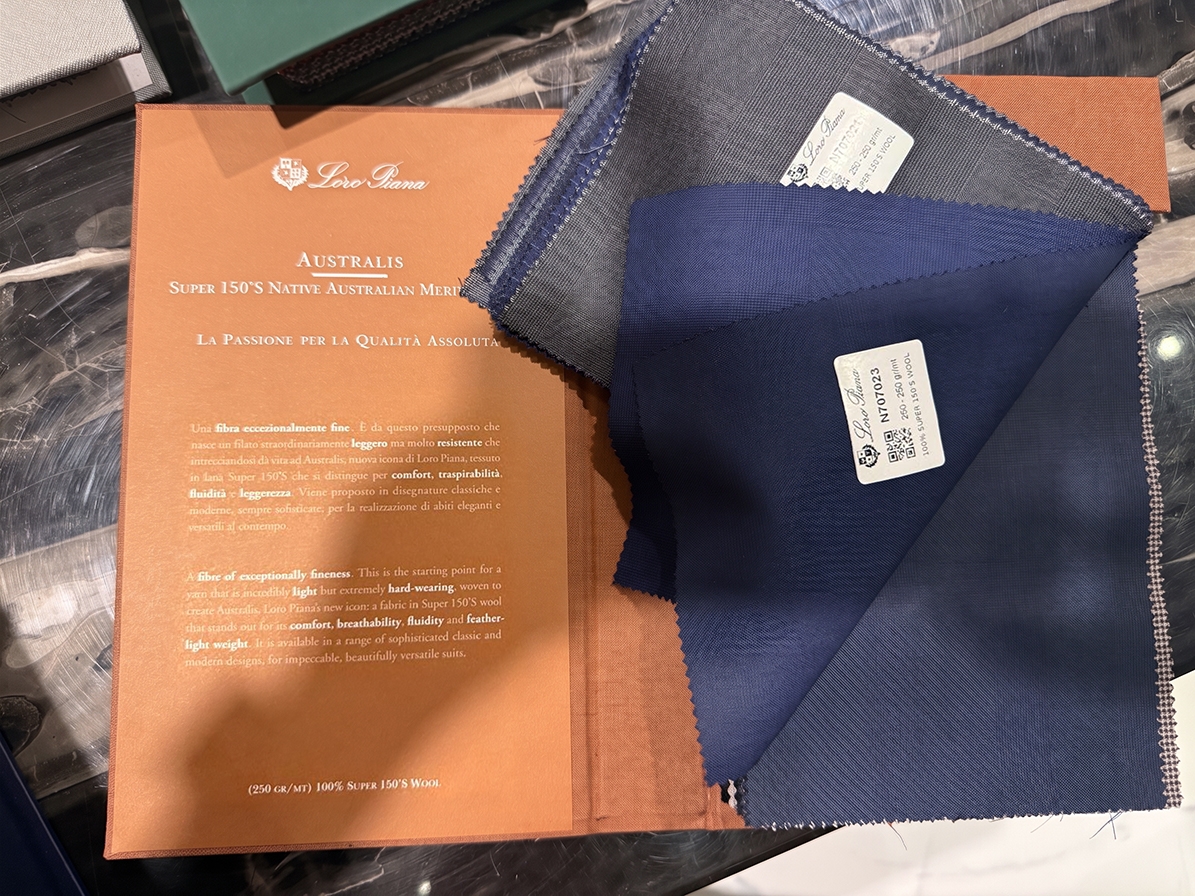
How we choose the right fabric for a bespoke suit
A good fabric should not be chosen solely by the “Super 150’s” label or by the reputation of the mill. For a bespoke suit, we consider together how often it will be worn, the season, type of event, temperature, fabric construction, weight, crease resistance, sheen, drape and how the material responds to tailoring. For this reason, a frequently worn business suit may be better suited to a robust Super 110’s–130’s wool, while for a wedding, tuxedo or special suit we may move up to Super 150’s–180’s, cashmere, silk, mohair or barathea.
What Super 130’s, Super 150’s, Super 160’s, Super 170’s and Super 180’s mean
The Super S classification relates to the fineness of the wool fibre used in worsted fabrics. As the number increases, the maximum permitted average fibre diameter decreases. In practical terms, a finer fibre can produce a more delicate, supple and refined fabric, although the final performance of the cloth also depends on how the yarn is spun and woven.
| Classification | Maximum average fibre diameter | General characteristics | Recommended use |
|---|---|---|---|
| Super 130’s | 17.25 μm | Fine, balanced, versatile | Premium business, ceremony, suits worn relatively often |
| Super 140’s | 16.75 μm | Finer and softer | Luxury business, ceremony, all-season suits |
| Super 150’s | 16.25 μm | Very fine, fluid and elegant | Premium suits, ceremony, eveningwear |
| Super 160’s | 15.75 μm | Higher luxury, exceptionally fine handle | Luxury bespoke suits and special occasions |
| Super 170’s | 15.25 μm | Highly refined and exclusive | Tuxedo, ceremony and suits for connoisseurs |
| Super 180’s | 14.75 μm | Extremely fine and sophisticated | Luxury suits, special events, collector-level wardrobe |
The micron values represent the maximum limits for average fibre diameter under the international Super S classification. The actual construction of the fabric must always be considered when selecting a material.
What 2-ply, double-twist and 4-ply mean in suiting fabric
The term 2-ply does not mean “two layers of fabric”. It generally means that two individual yarns are twisted together to form a more stable yarn. Depending on the fabric, this construction may be used in the warp, the weft or both directions. Textile houses also use terms such as double-twisted yarn or double twist.
For a suit, a well-twisted yarn can contribute to structure, crease recovery, tailoring precision and durability. This is why very fine fabrics, including Super 150’s or Super 180’s, may use 2-ply or even 4-ply constructions to combine fineness with a firmer body. Final weight is not determined by ply count alone: density, yarn count and weave structure remain equally important.
Barathea / Grain de Poudre: one of the best choices for a tuxedo
Barathea is a classic evening fabric, recognised for its subtly textured surface, elegant appearance and usually more matte than glossy finish. In British and French tailoring, the term grain de poudre. It is used especially for tuxedos, dinner suits, smoking jackets and formal suits, because it absorbs light beautifully, highlights satin or grosgrain lapels and maintains a sophisticated appearance in photographs.
Depending on the collection, barathea can be woven from worsted wool, very fine Super S wool or blends with silk and cashmere. For a Filip Cezar tuxedo, we can adapt the choice to the season: lighter options for summer events and more substantial versions for autumn/winter.
Cashmere in bespoke suits: when it is worth choosing
Cashmere is valued for its fineness, warmth, low weight and exceptionally soft handle. In tailoring, it is used both in 100% cashmere fabrics for jackets and coats and in blends with Merino wool, silk or other fibres. Even a percentage of cashmere can significantly change the hand of a fabric, adding softness and depth.
For a complete suit intended for intensive wear, we do not choose cashmere simply because it is more expensive. We first assess the required durability, because a very soft fabric may be better suited to a jacket, dinner jacket, formal suit or rotation wardrobe than to trousers worn daily. By contrast, for a winter jacket or a luxury suit intended for special occasions, a fine wool and cashmere blend can offer an excellent balance of comfort and elegance.
Fabric weight: summer, all-season or winter
| Indicative weight | Feel | Season / use | Construction examples |
|---|---|---|---|
| 190–230 g/m | Very lightweight | Summer, warm destinations, summer ceremonies | Tropical, fine worsted, wool-silk, wool-mohair |
| 230–270 g/m | Lightweight and versatile | Spring-summer, indoor wear, many modern all-season fabrics | Super 130’s–180’s, fine twill, plain weave |
| 270–320 g/m | Balanced / more body | All-season, business, ceremony, autumn | 2-ply, twill, compact worsted |
| 320 g/m+ | Substantial and structured | Autumn-winter, coats, suits with a stronger presence | Flannel, 2-ply/4-ply, heavy worsted, cashmere blends |
The ranges are indicative. A fabric of the same weight can behave very differently depending on fibre, weave, density and finishing.
Fabrics for different budgets: from smart premium to ultra-luxury
The price of a fabric is not determined solely by its Super number. The mill, origin and rarity of the fibre, composition, complexity of the weave, collection, finishing and availability all matter. For this reason, in our atelier we build the selection around different levels of use and budget without compromising technical suitability.
Textile houses and bunches available for Filip Cezar Bespoke suits

Loro Piana – fine wool, cashmere and rare fibres
Loro Piana is one of the international benchmarks for fabrics and products made from exceptionally fine natural fibres. In a bespoke suit, these materials are chosen for their refined handle, drape and comfort. For Filip Cezar clients interested in luxury jackets and suits, we focus above all on the balance between fineness, weight and how the garment will actually be worn, not only on the prestige of the name on the bunch.
Scabal – from Super 130’s to Super 180’s and special collections
Scabal offers an exceptionally broad range for tailoring: from versatile Super 110’s–130’s fabrics and Super 150’s collections through to Super 170’s–180’s, cashmere and special editions featuring rare fibres. It is particularly relevant when we want to calibrate a suit precisely for season, weight and level of formality: business, ceremony, tuxedo or a luxury suit for special events.

Holland & Sherry – fabrics for Black Tie, Super S and cashmere
Holland & Sherry is an essential British textile house for classic and formal tailoring. Its selections include worsteds in multiple Super S grades, barathea for Black Tie and luxury blends with cashmere and silk. For a groom or a tuxedo, these bunches allow us to choose not only the colour, but also the appropriate level of sheen, texture, weight and drape for photography and event lighting.
Dormeuil – Grain de Poudre, Super S and formal fabrics
Dormeuil offers collections dedicated to formal suits and eveningwear, including Grain de Poudre / Barathea, as well as Super S ranges and cashmere blends. For a tuxedo, a more matte surface and controlled drape may be preferable to a highly lustrous cloth, especially when the lapel is made from satin, grosgrain or velvet.

Vitale Barberis Canonico – an excellent balance of performance and refinement
Vitale Barberis Canonico is one of the most versatile choices for a bespoke suit. The range covers business, formal and evening fabrics, including Super 150’s and Super 180’s. Some constructions use double-twisted yarns to combine fineness with greater compactness and resilience. For clients looking for a smart entry into the premium segment, VBC often offers an excellent balance of quality, durability and breadth of selection.

Drapers – Italian style for bespoke suits
Drapers is appreciated for elegant, contemporary menswear selections suited to both business and formal suits. In the atelier, a Drapers bunch can be an excellent choice for a client who wants a fabric with Italian character, deep colours and elegant drape without necessarily pursuing the highest Super number.

Carnet – wide variety for business, ceremony and jackets
Carnet offers a broad range of fabrics for suits and jackets, with numerous textures, colours and weights. It is particularly useful when a client wants to compare several budget and style options quickly while maintaining the fabric standard expected of a bespoke garment.

Zegna – fine wool and sophisticated blends
Zegna fabrics are associated with luxury tailoring and selections of fine Merino wool, sometimes blended with silk, cashmere or other fibres. For a Filip Cezar suit, the choice depends on how fluid or structured the finished garment needs to be and how frequently it will be worn.

Lanificio F.lli Cerruti – Italian fabrics for luxury tailoring
Cerruti is well suited to clients looking for an Italian fabric with a refined handle and elegant drape. For formalwear, we pay particular attention to the depth of black or other shades, how the surface responds to light and the stability required for precise bespoke construction.

Carlo Barbera – fabrics with Italian sartorial character
Carlo Barbera is an option for suits and jackets where the client wants a refined fabric with a pleasant handle and understated appearance rather than an ostentatious effect. Such a cloth can highlight the clean lines and fine adjustments of a bespoke pattern exceptionally well.

Reda – versatile fabrics for business and formal wardrobes
Reda is a suitable choice for clients looking for versatile premium fabrics, from business suits to formalwear. With the right selection, the material should provide sufficient fineness while also offering recovery and stability for the suit’s real-world use.

Marzotto – premium options for an efficient budget
Marzotto covers a broad range of fabrics for suits and jackets and can be relevant for clients who want a premium cloth at a more efficient budget than ultra-luxury ranges. Selection is based on composition, weight and intended use, not only on the collection name.
Premium fabrics for bespoke shirts

Albini – premium cotton for bespoke shirts
For business, formal or casual shirts, Albini offers a very wide variety of constructions and finishes. When selecting a fabric, we consider density, breathability, transparency, ironing behaviour and how well the fabric supports the collar and cuff.

Thomas Mason – poplin, twill, oxford and luxury cotton
Thomas Mason is well suited to bespoke formal and business shirts, with selections of poplin, twill, oxford and other classic constructions. For a white tuxedo shirt, for example, we choose differently than for a business shirt: opacity, fineness, the stiffness required for the collar and resistance to wear become distinct criteria.

Tessitura Monti – Italian fabrics for business and formal shirts
Monti offers numerous options for bespoke shirts, from fine formal fabrics to more practical materials for business. The right choice depends on climate, collar type, acceptable degree of transparency and frequency of use.
Frequently asked questions about fabrics for bespoke suits
Is Super 180’s better than Super 130’s?
Not in every situation. Super 180’s uses a finer fibre and can offer a more luxurious feel, but a well-constructed Super 130’s can be more suitable for a suit worn frequently. “Better” means the right material for the intended use, season and the client’s style.
What is the best fabric for a wedding suit?
For most weddings, a well-chosen Super 130’s–160’s wool offers an excellent balance of appearance, comfort and durability. For a tuxedo, we may prefer barathea / grain de poudre, mohair or an evening worsted. For an ultra-luxury garment, we may move up to Super 170’s–180’s, cashmere or silk blends.
What is a 2-ply fabric?
2-ply describes a yarn formed by twisting two individual yarns together. In tailoring, this construction can increase fabric stability and resilience. It does not mean two layers of cloth and does not, by itself, indicate the final weight.
What is barathea and why is it suitable for a tuxedo?
Barathea is a formal fabric with a subtly textured surface and an elegant, usually more matte appearance. It is traditionally used for Black Tie because it photographs well, drapes beautifully and creates an elegant contrast with satin or grosgrain lapels.
Is cashmere suitable for a full suit?
Yes, but it depends on the construction and how frequently the suit will be worn. Cashmere adds softness and warmth, but for trousers worn very often we may prefer a composition with a higher proportion of worsted wool. For jackets, formal suits and luxury garments, cashmere can be an excellent choice.
What fabric weight is suitable for a summer suit?
As a guideline, many summer fabrics fall roughly within the 190–250 g/m range, but breathability depends greatly on the weave and fibre. A tropical wool or mohair blend may breathe better than a very dense fabric of the same weight.
Which fabrics are suitable for a more controlled budget?
For an efficient budget, we first recommend a well-constructed quality wool rather than necessarily choosing a very high Super number. Super 110’s–130’s from established manufacturers can offer an excellent balance of appearance, comfort and durability.
Why fabric matters in a 100% bespoke suit
Filip Cezar works on a bespoke / custom made, rather than starting from a finished industrial suit that is simply altered to the client’s measurements. The fabric is selected before the pattern and construction are finalised because thickness, natural stretch, drape and fabric behaviour influence tailoring allowances, lapel shape, chest construction, trouser line and how the garment sits on the body.
To book an appointment at the Filip Cezar atelier in Bucharest, the selection can begin with the intended use of the suit, season, colour and budget. We then compare real swatches from our bunches and choose the most suitable fabric.